
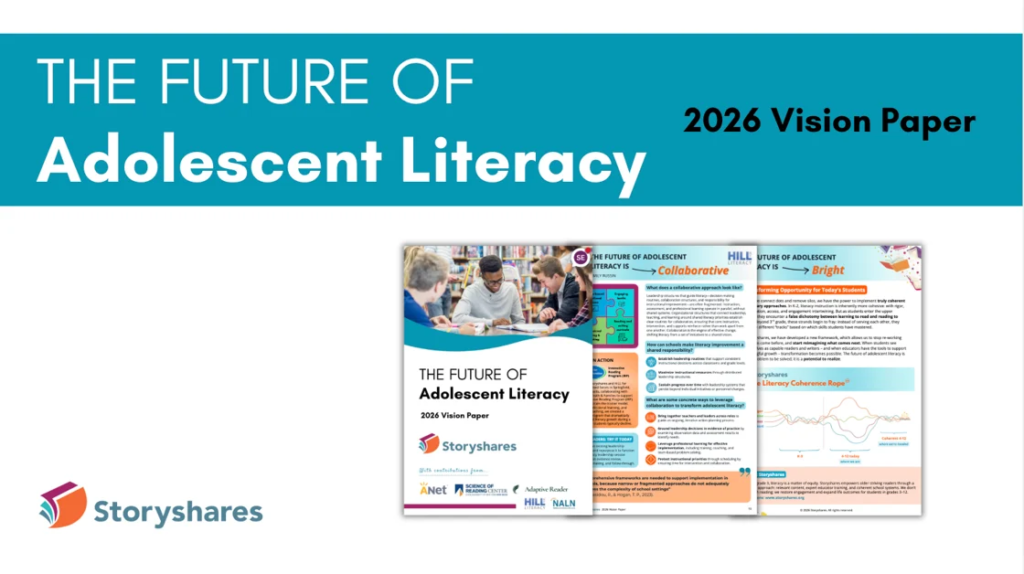
On Monday, May 11, Storyshares launched The Future of Adolescent Literacy, a “blueprint for what it actually takes to transform outcomes for students in grades 4-12.”
“This is not another program or disconnected solution; it is a fundamentally different way of looking at adolescent literacy. The problem isn’t that we don’t know what works; it’s that what works is rarely connected, aligned, and implemented as a coherent system.”
Storyshares recognizes the need to build systems tailored towards adolescents.
The Future of Adolescent Literacy proposes that systems must be built on the following:

coherent
where core instruction and intervention are no longer disconnected, but intentionally aligned

accessible
where every student can engage with text through language, format, and entry points that meet them where they are

infrastructural
where literacy is supported by schedules, systems, and leadership — not left to chance

evidence-based
where instruction is grounded in the science of reading and proven across contexts

data-driven
where instruction responds to what students actually need, in real time
disciplinary
where literacy lives across subjects, not just in ELA classrooms
collaborative
where responsibility is shared across roles, not isolated within individuals

teen-centered
where identity, choice, and relevance are foundational, not secondary
Storyshares’ Vision Paper is a culmination of the collaboration between educators, systems leaders, and organizations working at the forefront of adolescent literacy, including ANet (Achievement Network), The Science of Reading Center at State University of New York, New Paltz, Adaptive Reader, HILL for Literacy, and NALN (Nevada Adolescent Literacy Network).
Hope for Youth & Families highlights the positive impact a collaborative approach can have on adolescent literacy. In 2024, Storyshares and HILL for Literacy joined forces to support our Innovative Reading Program (IRP).
“Through a train-the-trainer model, weekly professional learning, and ongoing coaching, we created a summer program that dramatically accelerated literacy growth during a time when students typically decline.”
Learn more about The Future of Adolescent Literacy.